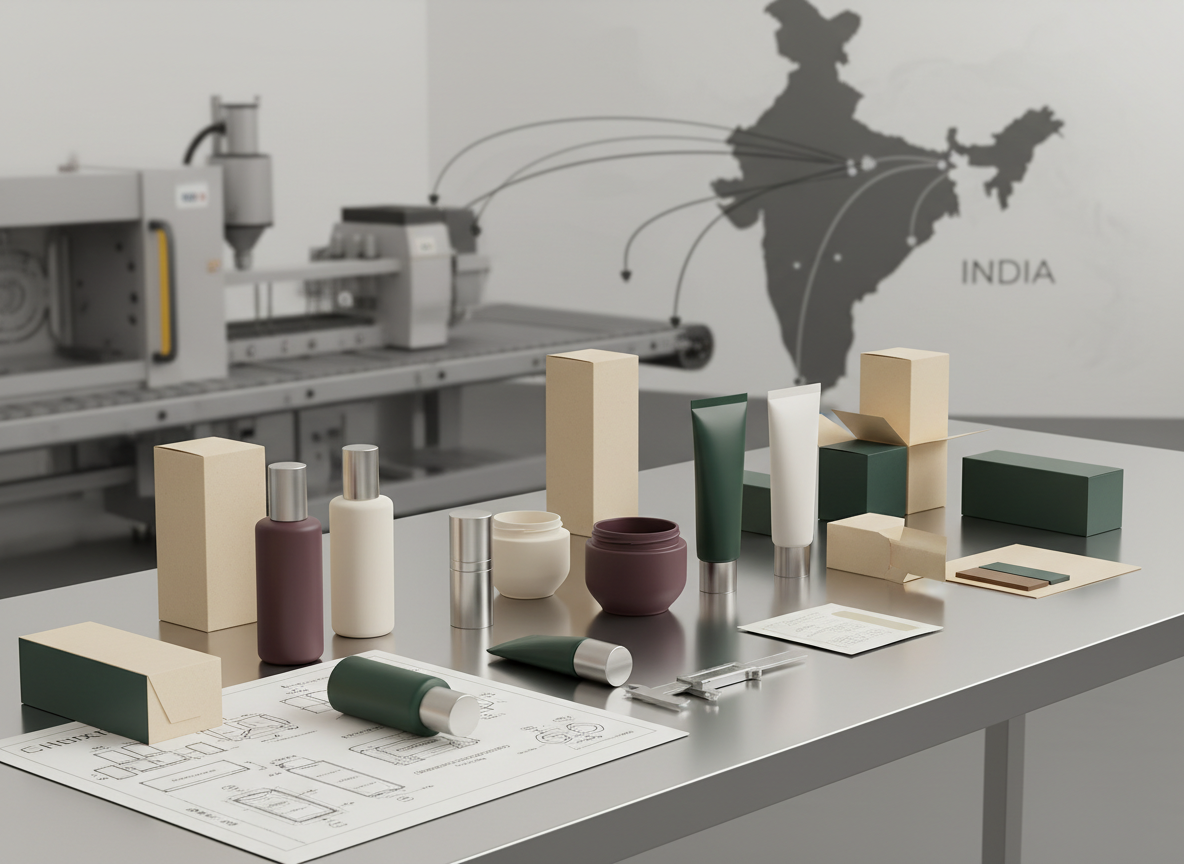
Cosmetic packaging is one of the easiest parts of a beauty launch to underestimate. A bottle or pump may look like a branding decision, but it also affects formula stability, leakage, dispensing, freight, breakage, minimum order quantities, working capital and customer reviews.
For Indian beauty brands comparing cosmetic packaging manufacturers and suppliers, the useful question is therefore not simply who can supply the most attractive component. It is which packaging system can protect the formula, communicate the brand and scale at workable economics.
Packaging starts with the formula
The container and formulation have to work together. Oils can migrate or leak, active formulations can interact with packaging materials, viscous products can fail in pumps and volatile components can change during storage. Compatibility should be evaluated before committing to a large component order.
That makes packaging development part of product development rather than the final visual-design stage.
MOQ economics can be more important than component price
A supplier may quote an attractive per-unit price at a quantity far above the brand’s realistic first-year demand. Custom colours, printing, moulds, pumps and cartons can each carry different minimums. Founders should calculate the cash tied up across the entire packaging system rather than compare bottle prices in isolation.
Standard components can reduce launch risk because they may be replenished in smaller quantities. Custom tooling can create stronger visual ownership but should usually be justified by proven demand or a strategically important pack format.
Premium packaging has to survive ecommerce
Beauty packaging is increasingly designed for social feeds and retail shelves while much of the product travels through courier networks. Secondary packaging, seals, closures and component durability have to survive fulfilment. A premium glass bottle that repeatedly arrives damaged can be commercially worse than a less dramatic pack with better transit performance.
Labelling requirements need space in the design
India’s Cosmetics Rules, 2020 contain packaging and labelling requirements, including prescribed information on cosmetic packs. The practical implication is straightforward: regulatory copy cannot be treated as an afterthought once the visual artwork is finished. The chosen component and carton need enough usable area for compliant declarations.
Brands should complete product-specific regulatory review before printing at scale because imported and domestically manufactured cosmetics can have different operating requirements.
Sustainability claims need operational substance
Eco-friendly packaging is becoming a more visible consideration for beauty brands, but “sustainable” should describe a specific, defensible packaging choice rather than a vague marketing position. Material reduction, refill systems, recyclability, mono-material design, recycled content and lower secondary-packaging use can each involve different operational trade-offs.
Any environmental claim should be specific enough to substantiate. A package can also become environmentally inefficient if it causes high breakage, product waste or complicated disposal.
A supplier scorecard for beauty brands
AdvertisR would compare packaging suppliers across component quality, compatibility support, MOQ, tooling requirements, decoration capability, lead time, defect handling, replenishment reliability, freight economics and documentation. For custom components, ownership of moulds and tooling should also be clear.
AdvertisR’s view: the best cosmetic packaging is not the pack that looks most expensive in a launch photograph. It is the one that protects the product, communicates the proposition, survives the channel and can be replenished without creating unnecessary inventory risk.
Regulatory note: the Cosmetics Rules, 2020 contain current packaging and labelling provisions for cosmetics in India. Product-specific requirements should be verified with qualified regulatory professionals before production.