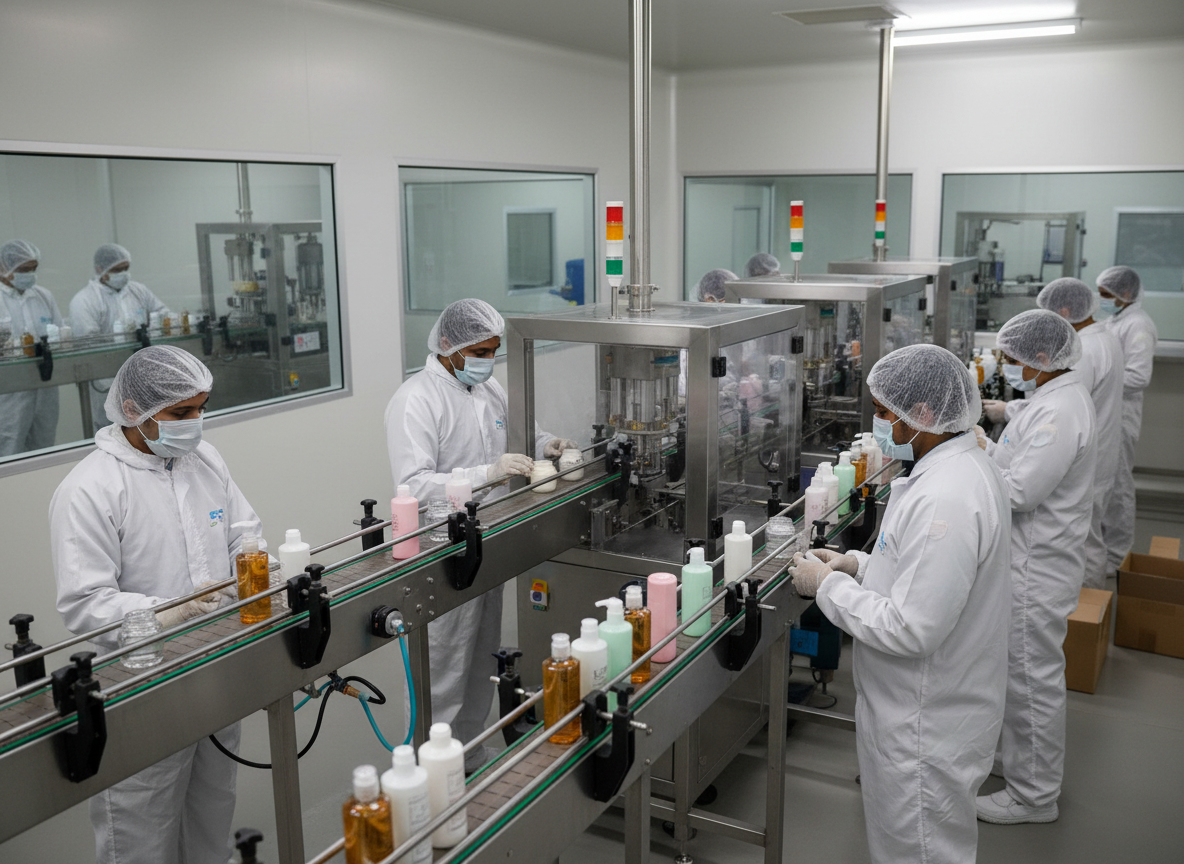
Updated October 2026. A beauty brand may own the name, customer relationship and product idea without owning the factory that makes the product. Understanding that distinction is fundamental to understanding how India’s beauty industry works.
Cosmetic manufacturing sits behind skincare, haircare, makeup, personal-care and professional-beauty brands. Founders need to decide not only what to launch, but who will formulate it, manufacture it, test it, pack it and consistently reproduce it as the brand grows.
Use this as the manufacturing process overview. This guide follows how a beauty product moves from concept to production and quality checks. To compare the contractual and formula-ownership differences between sourcing models, consult our third-party versus private-label comparison. Requirements depend on the product and jurisdiction; verify licensing with the relevant authority.
Why cosmetic manufacturing matters to beauty founders
Manufacturing decisions affect a beauty brand’s capital requirement, gross margin, launch speed, product differentiation, quality risk and ability to scale. The factory may be invisible to the customer, but its economics and reliability sit underneath the brand promise.
For founders, these decisions are commercially meaningful because manufacturing choices determine how much capital is committed, how quickly products can reach market and how much control the brand retains over quality and differentiation.
The main cosmetic manufacturing models
| Model | What it generally means | Founder implication |
|---|---|---|
| Own manufacturing | The brand controls or owns the production facility | Greater operational control but significantly more infrastructure and compliance responsibility |
| Contract / third-party manufacturing | An external licensed manufacturer produces products for the brand | Allows the brand to focus more capital and management attention on product, distribution and demand |
| Private label | A manufacturer offers an existing or adaptable product base that multiple brands can commercialise under their own identities | Can reduce development time but differentiation needs careful consideration |
| Custom formulation with external manufacturing | The brand develops a more specific formula with a manufacturer or formulation partner and outsources production | Potentially stronger differentiation, usually with more development work, testing and commercial commitment |
Third-party manufacturing is not the same as private label
The terms are frequently used interchangeably, but founders should clarify exactly what a supplier is offering. Third-party manufacturing describes who produces the goods. Private label more often describes a product-development model in which a manufacturer has an existing product or formula that can be branded by another business.
A third-party manufacturer may also develop custom products. The commercial agreement, formula ownership, exclusivity and intellectual-property terms therefore matter more than the label used in a sales conversation.
How a cosmetic product moves from idea to production
- Product brief: define the customer, use case, format, desired experience, claims direction, price architecture and channel.
- Manufacturer / formulation search: identify suppliers with relevant category capability and appropriate licences.
- Sampling and development: review formula, texture, fragrance, colour, packaging compatibility and user experience.
- Testing and documentation: establish the testing, specifications and records required for the product and claims.
- Commercial quotation: confirm manufacturing price, packaging, MOQ, taxes, development charges and other commercial terms.
- Artwork and labelling: prepare compliant packaging information and production-ready files.
- Pilot / first production: manufacture the approved batch under agreed specifications.
- Quality release: review the required quality records before commercial distribution.
- Scale and repeat production: forecast inventory and maintain batch-to-batch consistency.
MOQ can shape the entire business model
Minimum order quantity is not merely a factory negotiation. It determines how much cash is committed before the brand knows its true sell-through rate.
A lower unit cost at a much higher MOQ can be economically worse for an early-stage brand if inventory moves slowly, packaging changes, the formula needs improvement or working capital becomes trapped.
Founders should model cash invested per SKU, not only manufacturing cost per unit.
Manufacturing cost is only part of product cost
- Bulk formulation / manufacturing
- Primary packaging
- Secondary packaging
- Labels, printing and decoration
- Testing and development charges
- Freight and warehousing
- Damage and leakage allowance
- Marketplace or channel economics
- Promotional sampling and testers where relevant
- Inventory financing and obsolescence risk
A product with an attractive ex-factory quote can still have weak brand economics after packaging, fulfilment, channel commissions, discounts and customer acquisition are included.
How to evaluate a cosmetic manufacturer
- Verify the entity and manufacturing location
- Verify applicable manufacturing licences and scope
- Understand which categories the facility actually produces
- Ask about quality systems and batch documentation
- Review development and sampling capability
- Clarify MOQs by SKU and packaging format
- Understand lead times for first and repeat production
- Ask how raw-material or packaging changes are controlled
- Clarify formula ownership, confidentiality and exclusivity
- Understand complaint, recall and non-conformance processes
- Speak with existing customers where appropriate and permitted
Do not choose a factory from price alone
The cheapest quotation can become expensive if batches are inconsistent, packaging leaks, production is delayed or the supplier cannot support the documentation required by the brand’s channels.
Supplier selection should consider total commercial risk: quality, reliability, communication, compliance, scalability and the consequences of a failed batch.
What about cosmetic manufacturing licences in India?
Cosmetics sold in India operate within a regulated framework, and manufacturing requirements depend on the product and operating structure. A founder should establish the applicable licensing and compliance path before committing to commercial production.
Founders should verify current requirements directly with the relevant government authorities and qualified regulatory professionals. Outsourcing manufacturing does not eliminate the brand’s responsibility to understand the products it places into the market, its labelling, claims and supplier documentation.
Claims should be considered before manufacturing, not after
A marketing team may want to describe a product as clinically tested, dermatologically tested, natural, organic, clean, anti-acne or capable of delivering a specific performance outcome. Those words can carry evidence and regulatory implications.
The product brief should therefore align formulation, testing, packaging and marketing claims early. Creating the claim after production can leave the brand without the evidence required to support it.
Private label can be strategically useful, but it is not a strategy by itself
Private-label manufacturing can help founders reach market faster, test a category or reduce initial product-development complexity. But if multiple brands can access similar products, differentiation has to come from somewhere else: positioning, customer understanding, packaging, distribution, service, community, content or channel execution.
The commercial choice should therefore be driven by the brand’s need for speed, differentiation, ownership and control, not by the manufacturing label alone. Founders should compare what is actually proprietary, what can be customised and what remains available to other brands.
Professional beauty brands have additional considerations
A salon-professional product is not simply a consumer product sold through a different channel. The manufacturer and brand may need to account for professional protocols, pack sizes, technical education, back-bar economics, repeated service use and compatibility with salon workflows.
This is where manufacturing connects directly with the salon ecosystem AdvertisR has been mapping: the product has to work not only on a product page but in the hands of the professional delivering the service.
The manufacturer-brand relationship changes as a brand grows
Early-stage brands often optimise for low MOQ and launch speed. Growing brands increasingly care about forecasting, repeatability, capacity reservation, payment terms, quality systems, supply continuity and cost optimisation.
Eventually, some businesses may diversify suppliers, negotiate dedicated capacity, deepen custom formulation or consider their own manufacturing. The right model can therefore change with scale.
A founder’s manufacturer due-diligence checklist
- What legal entity will manufacture the product?
- At which physical facility?
- Which applicable licences cover the product category?
- Who owns the formula?
- Is the formula exclusive?
- What is the MOQ per SKU?
- What is included and excluded from the quoted unit cost?
- What testing and documentation are supplied?
- What are first-order and repeat-order lead times?
- How are batch changes controlled?
- What happens when a batch fails specification?
- Who sources packaging?
- What payment terms apply?
- What capacity exists if demand grows rapidly?
- What happens to formula, moulds, artwork and packaging inventory if the relationship ends?
The AdvertisR view
The factory is invisible to most beauty consumers, but manufacturing decisions can determine whether a brand has healthy working capital, consistent quality and room to scale.
For founders, the goal is not simply to “find a cosmetic manufacturer”. It is to design a supply system that can support the brand promise economically and repeatedly.
This article begins AdvertisR’s deeper beauty-brand business cluster. Next layers include third-party and private-label manufacturing, cosmetic business planning, product economics, pricing, distribution and marketplace strategy.
AdvertisR is an independent beauty-business publication. Regulatory requirements can change and vary by product and operating model. This article is educational and is not legal or regulatory advice. Verify current requirements with official authorities and qualified professionals before manufacturing or selling cosmetics.