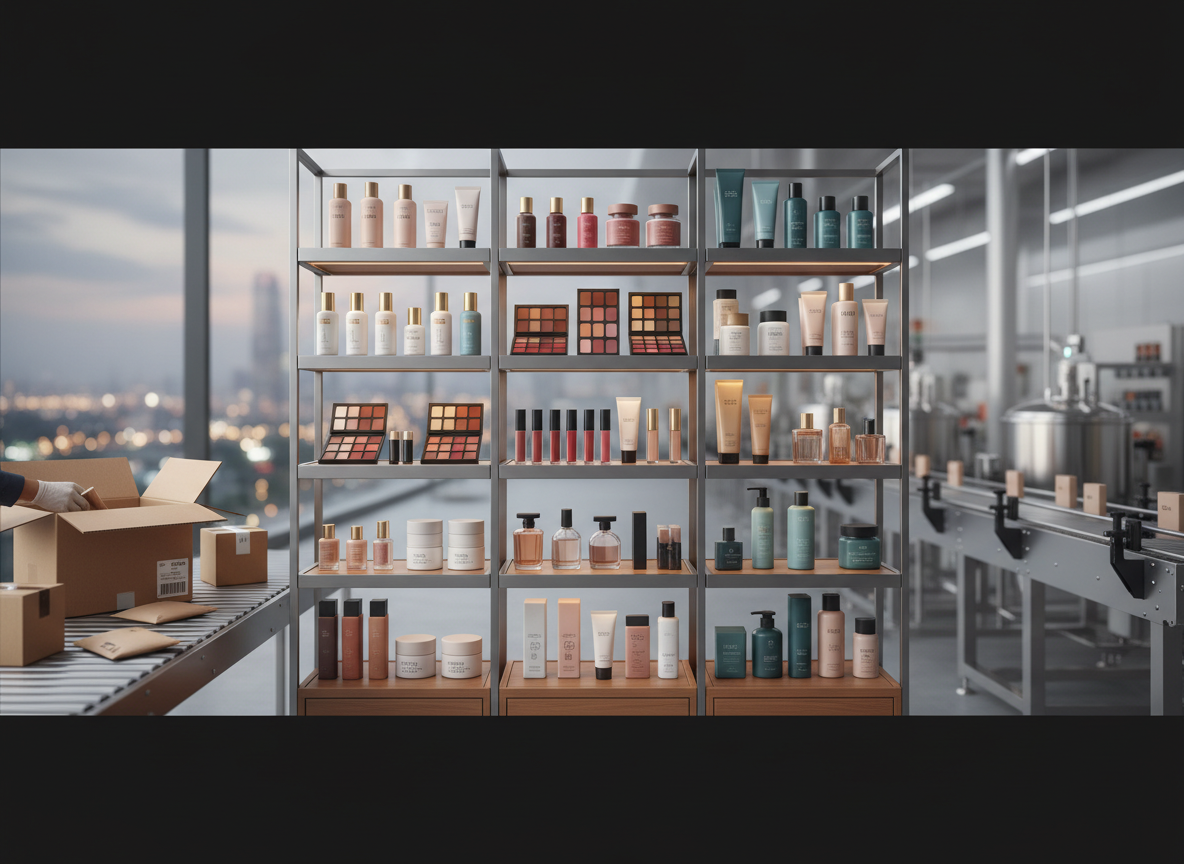
Updated September 2026. India’s cosmetic industry is moving through a structural shift rather than a simple growth cycle. Consumers are buying more specialised products, digital commerce is changing discovery and fulfilment, premium brands are expanding beyond metros, and homegrown companies are scaling faster across skincare, haircare, colour cosmetics, fragrance and professional beauty.
For founders, retailers, investors and operators, the more useful question is no longer whether India’s beauty market is growing. It is where the growth is moving, which channels are gaining influence, and what capabilities brands need to compete profitably.
How large is the cosmetic industry in India?
Current estimates vary depending on whether a source measures cosmetics alone or the broader beauty and personal care market. IBEF’s current ecommerce industry data says India’s beauty and personal care market is projected to reach about ₹2,60,610 crore (US$30 billion) by calendar 2027, representing roughly 5% of the global industry, with growth of around 10% annually. NielsenIQ separately describes India as one of the fastest-growing beauty markets globally and says the category is delivering double-digit growth.
Older IBEF research classified the Indian cosmetics industry across skin care, hair care, oral care, fragrances and colour cosmetics. That structure is still useful, but the boundaries are becoming less clean as beauty converges with wellness, dermatology, professional services and aesthetic treatments.
For a broader view of the market forces, see AdvertisR’s India beauty 2026 growth analysis.
Scope note: This guide focuses on India’s cosmetics and product-side beauty economy: categories, ecommerce, manufacturing, packaging, compliance and sourcing. For the broader ecosystem spanning beauty retail, creators, professional salons, capital and channel transformation, see AdvertisR’s India Beauty Industry 2026 master guide.
AdvertisR Beauty Business Brief
Building or operating in beauty?
Get the important moves in brands, retail, salons, commerce, creators and capital. Weekday signal, no inbox noise.
The six forces shaping India’s cosmetics market
1. Ecommerce has become infrastructure, not an alternate channel
Beauty ecommerce and quick commerce are now part of the core operating system of the category. IBEF reported that beauty ecommerce and quick-commerce sales grew 39% in value between June and November 2024 versus the previous year, compared with 3% growth in physical-store sales. The exact growth rate will change over time, but the structural shift is clear: beauty discovery and purchase are increasingly digital.
That is why brand strategy now has to span D2C stores, Amazon, Nykaa, Myntra, quick commerce and offline retail together. AdvertisR’s India beauty channel map explains how these routes are converging.
2. Premiumisation is expanding alongside value consciousness
Indian consumers are not moving uniformly toward premium products. They are willing to pay more when efficacy, experience, identity or convenience feels meaningful, while remaining highly price-conscious in everyday categories. That creates room for premium sunscreen, active skincare, fragrances and professional haircare, but it also puts pressure on brands to justify their price architecture.
3. New-age brands are changing category economics
IBEF, citing Bain & Company and DSG Consumer Partners, reported in June 2026 that new-age consumer brands in India were growing more than three times faster than the markets in which they operate. Beauty was one of the categories where insurgent brands were expanding materially faster than the broader market.
This matters because the competitive set is no longer simply multinational versus legacy Indian FMCG. It now includes digitally native skincare brands, creator-led propositions, specialist haircare, clean beauty, science-led brands and marketplace-native labels.
4. Quick commerce is changing launch and replenishment behaviour
Beauty products with high repeat rates and low consideration friction are increasingly suited to rapid-delivery platforms. The category is still uneven across cities and price bands, but quick commerce is becoming a meaningful discovery and replenishment layer rather than only an emergency channel.
AdvertisR has tracked this through stories such as Firi’s beauty quick-commerce funding and Amazon’s 2026 beauty expansion.
5. Professional beauty and consumer beauty are converging
Salons increasingly sell retail products, professional haircare is moving into consumer channels, and diagnostic-led consultations are becoming part of premium service delivery. At the same time, consumer brands are borrowing the language of salons, dermatology and professional expertise.
See AdvertisR’s five operating signals shaping professional beauty in India for the service-industry side of this shift.
6. Regulation and packaging are becoming more visible business variables
As the market gets more sophisticated, brands must manage not only marketing claims but also product authorisation, labelling, ingredient disclosure and packaging compliance. Recent regulatory developments include a Legal Metrology requirement for veg/non-veg origin dots on soaps, shampoos, toothpaste, cosmetics and toiletries, as well as CDSCO warnings around unauthorised imported beauty creams.
For operators moving from market analysis into execution, AdvertisR’s supporting guides cover cosmetic manufacturers in India, private-label cosmetics and MOQ economics, cosmetics compliance, labelling and claims, cosmetic packaging and supplier selection, and the roadmap to starting a cosmetic brand in India.
Which cosmetic categories look strategically important?
| Category | Why it matters in 2026 |
|---|---|
| Skincare | Actives, sunscreen, barrier care, naturals and science-led positioning continue to expand the addressable market. |
| Haircare & scalp care | Consumers are moving beyond shampoo and oil toward repair systems, scalp diagnostics, serums and professional solutions. |
| Colour cosmetics | Still a major discovery-led category, increasingly influenced by creators, celebrity platforms and omnichannel retail. |
| Fragrance | Premiumisation, gifting and international brand entry are strengthening the category. |
| Professional beauty | Salon chains, education, equipment and professional products create a parallel B2B ecosystem with different economics. |
| Beauty tech | AI-assisted discovery, diagnostics, virtual consultation and formulation technology are becoming competitive layers. |
What should beauty brands do differently?
- Build channel economics before channel presence. A brand does not need to be everywhere if contribution margins deteriorate across every marketplace.
- Treat product education as infrastructure. Search, creators, reviews and AI assistants increasingly shape the consumer’s pre-purchase research.
- Invest in repeatable product systems, not only launch frequency. Strong retention is more valuable than a calendar full of new SKUs.
- Build compliance into product development and packaging workflows instead of treating it as a final approval step.
- Use offline selectively. Physical retail and salon distribution can create trial and credibility, but only if store-level economics work.
- Measure category-specific repeat, not only total revenue growth.
AdvertisR outlook
India’s cosmetic industry has the ingredients for sustained growth: low per-capita penetration relative to mature markets, rising digital access, new consumer cohorts, stronger local brands and expanding organised retail. But the market is becoming harder to win because discovery is fragmented and customer expectations are rising.
The strongest businesses are likely to be those that combine product differentiation, disciplined channel economics, trusted education and faster consumer feedback loops.
Sources and methodology
This guide combines current market indicators with AdvertisR’s ongoing reporting. Key external references include IBEF’s India ecommerce industry analysis, NIQ’s India’s Beauty Moment 2026 report, and IBEF’s 2026 coverage of new-age consumer brands. Market estimates should be read according to each source’s category definition.
Cosmetic wholesale sourcing guides by city
AdvertisR is building a B2B sourcing map for beauty retailers, salons and resellers. Use the city guides below for market-specific sourcing areas, supplier checks and compliance risks.
- Cosmetic wholesale market in Delhi: B2B guide
- Cosmetic wholesale market in Mumbai: B2B guide
- Cosmetic wholesale market in Ludhiana: B2B guide
- Cosmetic wholesale market in Ahmedabad: B2B guide
- Cosmetic wholesale market in Surat: B2B guide
- Cosmetic wholesale market in Lucknow: B2B guide
- Cosmetic wholesale market in Jaipur: B2B guide
- Cosmetic wholesale market in Indore: B2B guide