A large salon conference can put professional beauty brands in front of decision-makers who are difficult to reach individually. Its business value becomes clearer after the event, when teams can see whether education led to product trials, paid usage and repeat orders.
What happened in Jaipur
KT’s own event account says it organised the Indian Hair & Beauty Conference with the Hair & Beauty Federation on 6 October 2026 at the Jaipur Exhibition & Convention Centre. It reports attendance of more than 5,000 salon owners from 18 states and over 50 cities.
Professional Beauty India’s coverage, dated 16 October, describes the gathering and its emphasis on education, Indian professional brands and salon cooperation. Its attendance figures are consistent with the organiser’s account; they should not be treated as a separate attendance audit. This article is a follow-up analysis of an earlier event.
The reviewed material does not disclose event costs, verified lead totals, subsequent orders or reorder performance. AdvertisR cannot calculate KT’s event return from the public information. What follows is a practical measurement approach for professional beauty teams planning comparable events.
Attendance and commercial eligibility are different measures
A badge scan may identify someone who attended a talk. It does not necessarily identify a buyer in a location the brand can supply. Before treating the attendee list as a sales pipeline, a brand should establish the person’s role, the salon’s operating location and the product discussion they actually requested.
A useful event record can be modest: salon identifier, city, contact permission, relevant service category, requested action and assigned owner. Avoid collecting unrelated personal details. Record an owner’s request for technical training separately from a distributor enquiry, since they require different follow-up.
This separation also protects the relationship. An owner who wanted an educator’s demonstration should receive that information, rather than being treated as ready for a large stock order.
| Event stage | Count this | Do not confuse it with |
|---|---|---|
| Attendance | People recorded as attending | Qualified salon buying interest |
| Qualification | Distinct salons with a relevant need in serviceable locations | Every badge or repeated scan |
| Trial | A completed product demonstration or agreed trial | A message sent or appointment proposed |
| Paid adoption | A fulfilled paid order | A sample, cancelled order or verbal commitment |
| Repeat demand | A later paid reorder after usage | The first distributor stock shipment |
Build a follow-up plan around serviceable demand
First, remove duplicate records and separate existing accounts from potential new accounts. A well-attended event may deepen an existing relationship without acquiring a new salon. Both can have value, but they answer different questions.
Next, assign the requested next step to someone who can deliver it. A demonstration requires an educator, product availability and a time the salon can accommodate. A supply enquiry requires a distributor or account manager who can confirm terms. A generic follow-up message cannot resolve those operational dependencies.
Track reasons when a salon does not progress. Price, unsuitable service mix, delayed supply and insufficient training point to different corrective actions. Recording all four as “not interested” makes it difficult to improve the next event.
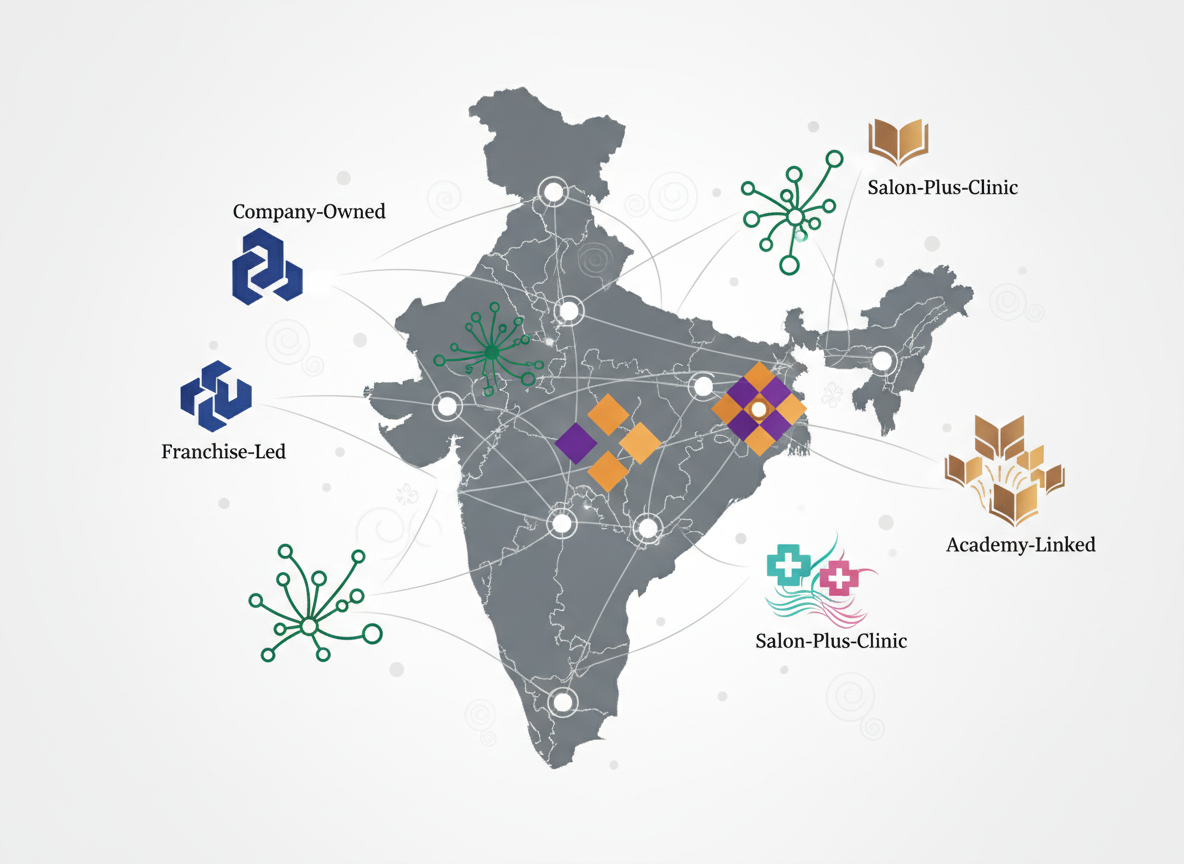
AdvertisR’s India salon network map explains why the route to a salon matters. The brand’s ability to fulfil and support an order in the owner’s city should be considered alongside the geographical reach of the audience.
A worked event calculation
Imagine an event with 100 qualified salons, of which 30 complete demonstrations, 12 place fulfilled paid orders and six later reorder. This is a hypothetical example, not IHBC data. Demonstration-to-first-order conversion is 12 divided by 30, or 40%. The observed reorder share of those first-order salons is six divided by 12, or 50%.
Those percentages need dates and denominators. A salon that bought yesterday has not had the same opportunity to reorder as one that bought six weeks ago. Group accounts by first-order date and evaluate them after a comparable usage window. Otherwise, an apparently weak reorder figure may reflect timing.
For economics, add event participation, samples, educator time, travel and subsequent selling costs that belong to the activity. Compare these with the contribution retained from fulfilled orders, using a consistent cost definition. Revenue alone cannot establish payback, and a distributor shipment should not be represented as consumption by end salons.
What salon owners can ask in return
Owners evaluating a conference partnership can ask for the training schedule, local supply contact, usage guidance and a clear way to obtain technical support. They can also test one relevant service before committing to an unnecessarily broad opening order.
For brands, these questions are useful signals of adoption risk. A credible programme should make it easier for a salon team to use the product consistently and replenish it when needed. The most informative follow-up to a large attendance announcement would therefore be evidence of supported, repeat usage over time.
Reporting method and image
This analysis uses KT’s company account and Professional Beauty India’s trade report, reviewed on 19 October 2026. Attendance remains an organiser-reported figure. No attendee interviews, private order records or audited event economics were available. The measurement table, calculations and suggested workflow are AdvertisR’s original analysis.
Featured image: reused editorial illustration of India’s salon network. It does not depict the IHBC venue, attendees or KT products.