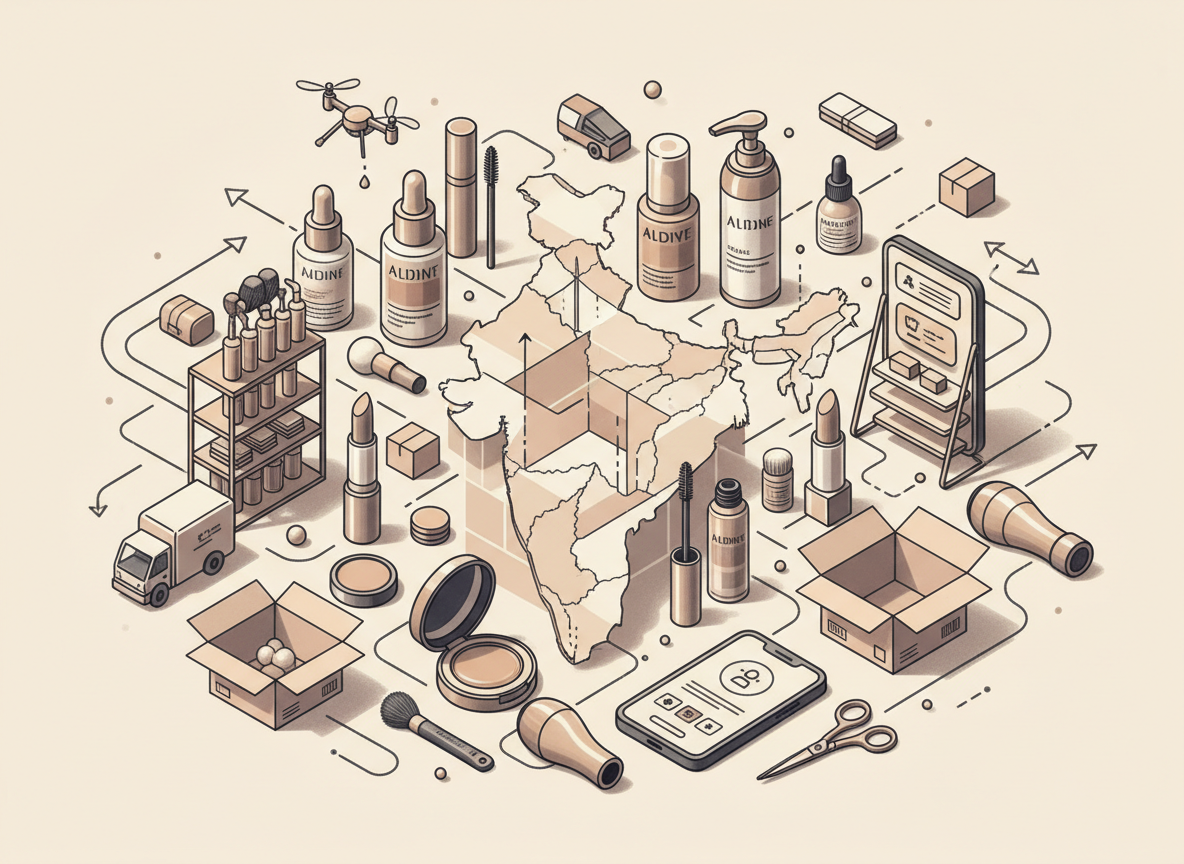
India’s beauty industry is moving from a fragmented consumer category into a more complex business ecosystem spanning legacy FMCG groups, digital-first brands, international entrants, professional beauty, marketplaces, specialist retail and quick commerce.
The headline opportunity is large. Redseer estimates India’s beauty and personal care market at about $23 billion in FY25 and projects it could reach roughly $40 billion by 2030, which would make India the world’s fourth-largest BPC market. But the more important story for operators is not market size alone. It is how the profit pools, discovery channels and routes to market are changing.
India beauty industry at a glance
- FY25 BPC market: about $23 billion, according to Redseer.
- 2030 opportunity: about $40 billion, with India projected to become the fourth-largest BPC market globally.
- Online BPC: Redseer estimates the online market reached roughly ₹56,000 crore in FY26, growing about 35% year on year.
- Quick commerce: its share of online BPC increased from about 9% in FY25 to roughly 18% in FY26.
- Scale remains concentrated: Redseer estimates only around 20 beauty and personal-care brands exceed ₹1,500 crore in revenue in FY26E.
These figures should be read as market estimates rather than audited industry totals. Different research firms use different category definitions, fiscal periods and channel boundaries.
1. India is becoming an omnichannel beauty market
Beauty used to be easier to describe by channel. Mass personal care moved through general trade. Premium products concentrated in malls and department stores. Digital-first brands built through marketplaces and D2C websites. Professional products moved through salons and distributors.
Those boundaries are weakening. A single beauty brand can now sell through its own website, Amazon, Flipkart, Nykaa, Myntra, specialist beauty retail, salons, general trade and rapid-delivery platforms. The commercial challenge is therefore shifting from channel access to channel orchestration: assortment, pricing, inventory, media and margins have to work together.
AdvertisR’s India Cosmetic Wholesale Market Map examines the physical B2B layer underneath this increasingly digital system.
2. Quick commerce is becoming a beauty channel, not just a convenience channel
Redseer estimates India’s online BPC market expanded from roughly ₹21,000 crore in CY22 to around ₹52,000 crore in CY25. Within that market, BPC gross merchandise value on quick commerce expanded approximately 22.5 times over the same period.
By FY26, Redseer estimates quick commerce represented roughly 18% of online BPC, up from about 9% a year earlier. Its Brand Index puts annualised BPC sales across leading quick-commerce platforms near $1 billion for January–March 2026, with more than 30 million monthly BPC shoppers.
The implication is category-specific. Replenishment-led products can benefit from immediacy, while considered purchases such as some makeup products still depend more heavily on assortment, content and discovery. Brands should not assume every SKU belongs on every rapid-delivery shelf.
3. Premiumisation is widening the middle of the market
India’s beauty growth is not simply a shift from inexpensive products to luxury. A significant opportunity is emerging between mass and prestige: consumers willing to pay more for ingredients, efficacy, packaging, identity and experience without necessarily entering traditional luxury price points.
This helps explain why global groups, Indian conglomerates and newer brands are competing for the same consumer through different propositions. The result is a denser market in skincare, haircare, makeup and fragrance, with brand differentiation becoming harder as product claims converge.
4. Digital-first brands are becoming acquisition and portfolio assets
The first D2C beauty wave demonstrated that brands could use social media, marketplaces and performance advertising to build demand without starting with national offline distribution. The next phase is more demanding. Scale increasingly requires retention, channel economics, supply-chain discipline and offline reach.
That is also why beauty has become an active field for strategic investment and acquisitions. Large companies can use digital-native brands to enter faster-growing subcategories or acquire consumer communities, while founders gain access to distribution, capital and operating infrastructure. AdvertisR tracks these shifts through its India Beauty Capital Map 2026.
5. Tier-2+ India is changing the geography of beauty demand
Beauty discovery is no longer geographically restricted to metro retail. Ecommerce, creator content and improved logistics have expanded access to products and trends in smaller cities. Redseer’s 2026 online-retail research says Tier-2+ markets are now outgrowing metros in beauty and personal care online growth.
For brands, this makes national availability different from national relevance. Assortment, price points, regional creators, distributor depth and delivery performance still determine whether digital awareness becomes repeat consumption.
6. Professional beauty remains a distinct business system
Consumer ecommerce captures much of the attention, but salons, makeup artists, academies, professional hair brands, skin professionals and specialist distributors form a separate commercial layer. Professional products can depend on education, stylist recommendation, technical performance and distributor relationships rather than consumer advertising alone.
AdvertisR’s Professional Beauty India industry guide maps this ecosystem in greater depth.
7. Creators are moving deeper into the transaction
Creators have long influenced beauty discovery. The business model is now extending beyond awareness into affiliate commerce, platform shopping integrations, founder-led brands, live commerce and measurable conversion.
That changes how beauty companies should evaluate influence. Reach remains useful, but audience-category fit, trust, content longevity and purchase behaviour become more important when creators sit closer to the transaction. AdvertisR tracks this shift through its coverage of India’s beauty creator economy.
Explore AdvertisR’s industry maps: Follow the Beauty Brands in India 2026 map for the competitive landscape, the India Beauty Channel Map for distribution, the Beauty Creator Commerce Map for influence-to-transaction models, the Professional Beauty India guide for salons and professional distribution, and the India Beauty Capital Map for investment and ownership. For the narrower product, manufacturing, compliance and packaging layer, use our Cosmetic Industry India 2026 guide.
What will decide the next phase of India’s beauty industry?
The market’s expansion creates opportunity, but growth will not be evenly distributed. Five capabilities are likely to matter disproportionately:
- Product-market fit beyond launch hype. Repeat purchase and genuine consumer utility become more important as acquisition becomes expensive.
- Channel economics. Brands need to know where each SKU can profitably win rather than chasing universal distribution.
- Inventory discipline. Beauty businesses must balance availability with expiry, working capital and marketplace discounting.
- Trust and differentiation. Ingredient language and creator endorsements are increasingly common, making proof and brand credibility more valuable.
- Regional execution. India’s next growth layer will require distribution and communication that work beyond the largest metros.
The AdvertisR view
The Indian beauty opportunity is no longer adequately explained by a single market-size number. The industry is becoming a network of overlapping systems: mass FMCG, premium retail, digital-native brands, professional beauty, creators, marketplaces, distributors and rapid delivery.
That complexity is precisely what makes the sector commercially important. The next generation of winners will be businesses that can build consumer belief while coordinating product, distribution, inventory, media and economics across channels.
Sources & verification
Primary market figures in this article are attributed to Redseer Strategy Consultants’ 2026 Beauty & Personal Care research, including India’s $40Bn Beauty & Personal Care Market, its FY26 online BPC analysis, and the Redseer Brand Index. AdvertisR has preserved the source’s estimates and time periods rather than presenting them as audited industry totals. Market estimates may differ across research providers because of methodology and category definitions.