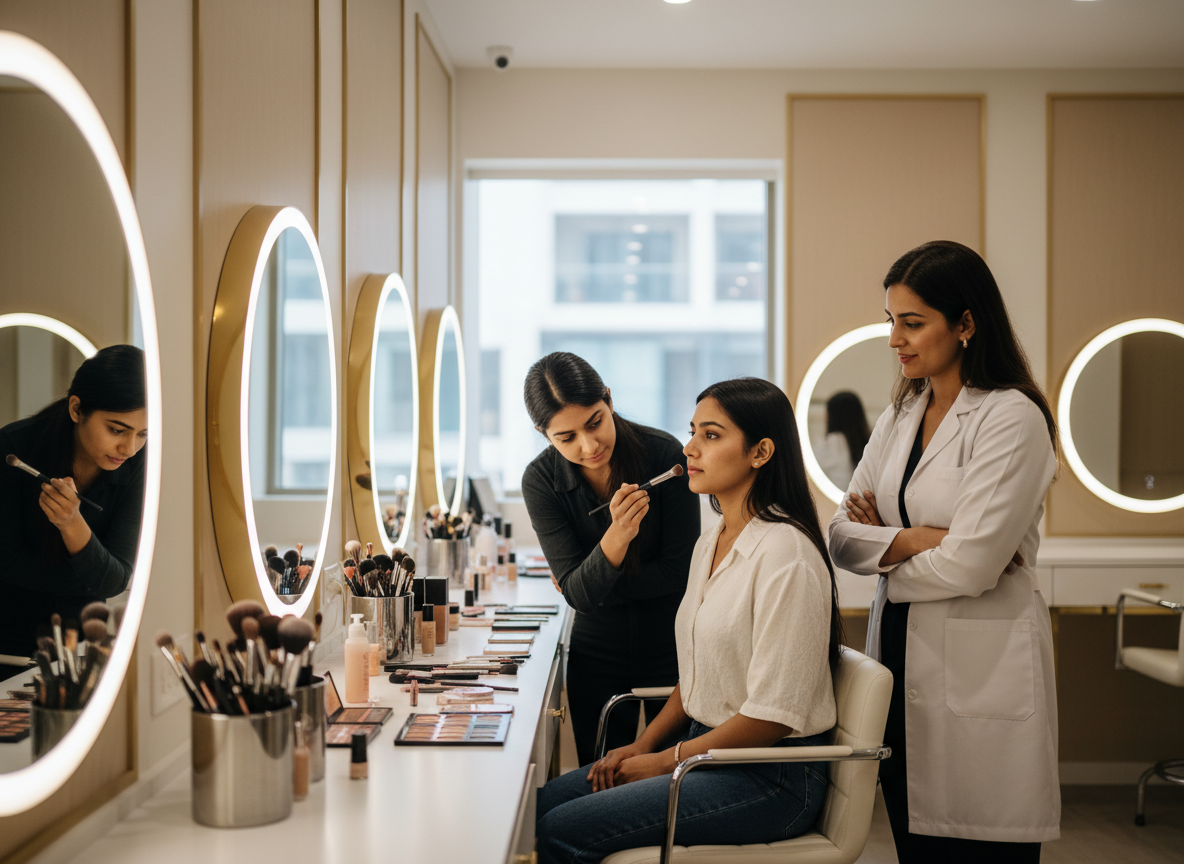
Updated October 2026. A makeup artist course can be a relatively fast entry into India’s professional beauty economy, but students face a confusing market of short workshops, certificates, diplomas, bridal programmes and advanced professional courses.
This AdvertisR guide explains how to evaluate a makeup artist course in India before paying: what you should learn, how fees work, what duration actually means, and whether the programme can help you become commercially ready.
Makeup artist course: quick overview
| Course formats | Short workshops, self-makeup, bridal, professional certificate, advanced and diploma-style programmes |
| Duration | Can range from days for workshops to several months for broader professional programmes |
| Eligibility | Varies by academy; many private professional courses do not require a beauty degree |
| Core outcome | Technical skill, practical confidence, portfolio and client readiness |
| Career routes | Freelance, bridal, salon, retail artistry, shoots, content and eventually entrepreneurship |
What are makeup artist course fees in India?
There is no single standard fee because programmes differ substantially in duration, faculty, products, location, brand reputation and the amount of supervised practical training. A weekend self-makeup class should not be compared directly with a multi-month professional programme.
Instead of asking only for tuition, ask the academy for the total cost of becoming course-ready: registration, classes, makeup kit, brushes, consumables, models, examinations, certification, portfolio shoots and optional masterclasses.
What should the syllabus include?
- Skin analysis and preparation
- Hygiene and sanitation
- Brush, tool and kit management
- Colour theory
- Foundation selection and complexion correction
- Concealing and colour correction
- Face shapes, contour and highlighting
- Eye shapes, liner, lashes and eye techniques
- Brow shaping and styling
- Lip correction and application
- Day, evening and occasion looks
- Bridal makeup where relevant
- Working on varied skin tones, ages and textures
- Client consultation
- Lighting and photography awareness
- Portfolio creation
- Pricing, bookings and basic freelance professionalism
Basic, bridal or professional course?
| Course | Best suited to | Main caution |
|---|---|---|
| Self-makeup | Personal grooming | Not designed for professional client work |
| Basic makeup | Beginners exploring the field | May not provide enough range for paid work |
| Bridal makeup | Artists focused on India’s wedding market | Check whether fundamentals are taught or assumed |
| Professional makeup | Students planning a career | Compare actual practical hours, not course labels |
| Advanced / master programme | Artists building specialised skills | Advanced branding does not guarantee advanced teaching |
How long does a makeup artist course take?
Course length alone is a weak quality indicator. A longer course can still contain limited practice, while an intensive programme can deliver substantial supervised work in fewer weeks.
Ask for the total teaching hours, practical hours, number of complete looks you will perform, assessment process and whether practice happens on real models. These figures are more useful than the number of calendar months printed on a brochure.
Can you do a makeup artist course after 12th?
Many private makeup programmes are skill-based and are accessible to students after school, although eligibility varies by provider. Students should verify the academy’s minimum age, educational requirements and certification conditions directly.
If you are choosing beauty as a first career, do not evaluate only the glamour of the profession. Consider client acquisition, weekend and wedding-season schedules, kit investment, travel, portfolio building and the time required to develop repeat customers.
Does the makeup kit come with the course?
Sometimes, but inclusions differ widely. Ask for an itemised kit list before enrolment. Find out whether products are full size, whether brushes are included, whether the kit is yours to keep and what additional products students normally purchase during the programme.
Certification: what does it actually mean?
A certificate confirms that a provider says you completed a programme or assessment. Its practical value depends on the issuing organisation, assessment standards and the employer or client evaluating you. Do not treat the word “international” or “certified” as proof of quality without asking who issues the credential and what standards it represents.
Career options after a professional makeup course
- Freelance artist: build your own local client base.
- Bridal artist: specialise in wedding and related events.
- Salon artist: work within a salon, studio or beauty chain.
- Beauty retail artistry: product demonstrations and customer-facing beauty roles.
- Creator work: makeup education, demonstrations and beauty content.
- Fashion/editorial: requires an appropriate portfolio, network and production experience.
- Entrepreneurship: eventually operate a studio, salon, academy or beauty service business.
What determines how much a makeup artist can earn?
Income is not determined by the certificate alone. Geography, niche, portfolio, client experience, reviews, network, seasonality, speed, reliability and positioning all influence earning potential. For the wider commercial picture, AdvertisR’s Makeup Artists in India 2026: Business & Influence Map shows how professional artists operate across bridal, salon, creator, education and brand ecosystems.
How to choose an academy
We have created a separate comparison framework for students evaluating institutes: Best Makeup Academies in India 2026. Use it to compare faculty, practical hours, batch size, kits, portfolios and career support rather than relying on follower counts or celebrity branding.
Makeup course vs beautician course
A makeup course is usually focused on cosmetic artistry. A broader beautician programme may include skin, hair, nails, grooming and salon-service modules depending on the curriculum. Students seeking broader beauty training should read our Beautician Course in India 2026 guide.
The business side students often underestimate
Technical skill gets you ready to perform the service. It does not automatically create demand. A working freelance artist also needs enquiries, consultation skills, pricing, deposits, scheduling, client experience, referrals, reviews and repeatable content or local discovery.
That is why beauty education should be viewed as part of the wider professional ecosystem mapped in AdvertisR’s India Professional Beauty Workforce & Skills Map 2026.
Checklist before enrolling
- Get the complete syllabus in writing.
- Confirm total classroom and practical hours.
- Ask who will teach your actual batch.
- Check batch size.
- Request an itemised fee and kit breakdown.
- Inspect recent student work.
- Ask how many different models you will practise on.
- Understand the certification.
- Clarify placement or career-support claims.
- Read refund, attendance and rescheduling terms before paying.
The AdvertisR view
A professional makeup course should be evaluated as an investment in employable skill, not as the purchase of a certificate. The most useful programme is the one that leaves you able to execute consistent work on real clients, show credible proof through your portfolio and understand how to turn that capability into income.
AdvertisR is an independent beauty-business publication. This article is educational and does not endorse a particular academy. Fees, course duration, curriculum and certification terms vary by provider and can change. Verify current information directly before enrolling.