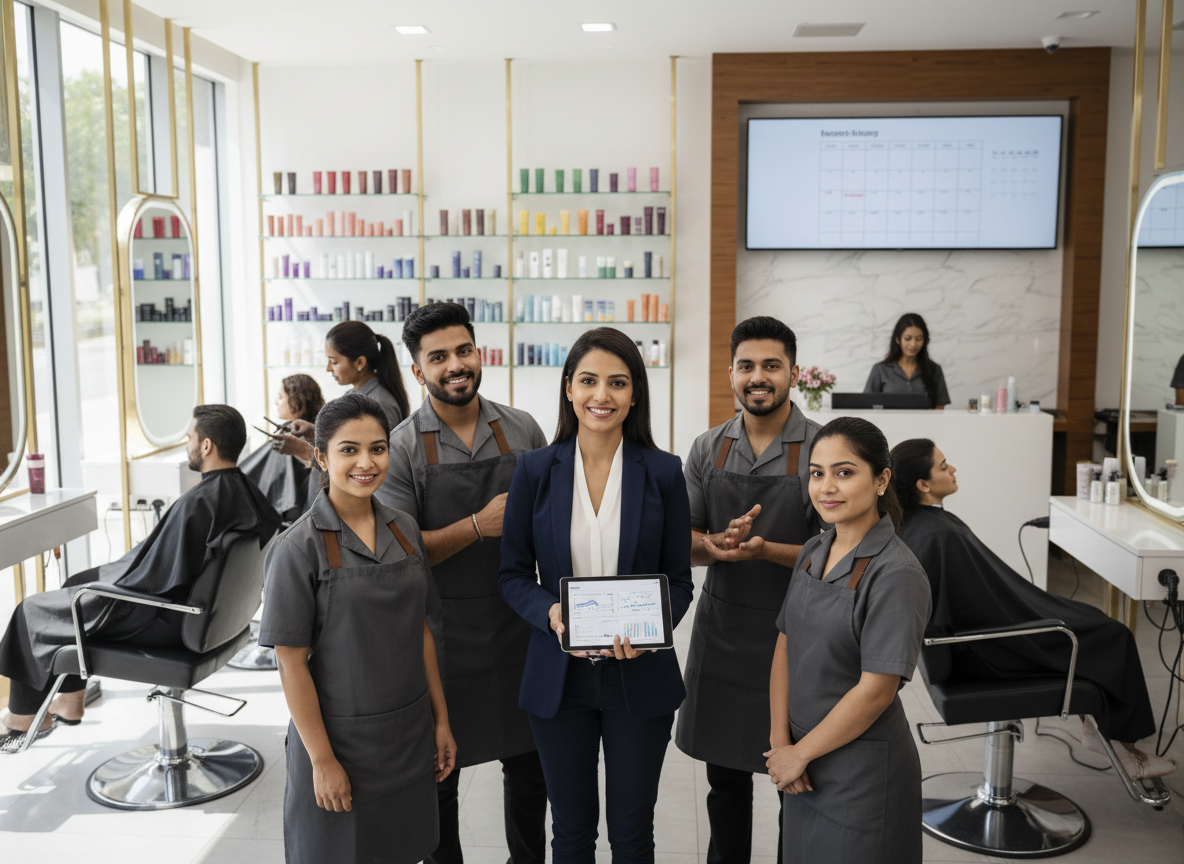
Updated October 2026. Salon management is not simply supervising staff and checking appointments. A professionally managed salon coordinates people, chairs, time, inventory, customer experience, service quality and cash flow every day.
For India’s beauty industry, this operating layer matters because demand alone does not create a profitable salon. The business must convert enquiries into bookings, bookings into completed services and completed services into repeat customers.
Scope: This article is an operating-system guide for staffing, bookings, service capacity and daily control. For the separate task of measuring net profitability, payroll contribution and service-level margins, use our salon profit-margin guide. A busy appointment book alone does not establish that a salon is profitable.
What is salon management?
Salon management is the system used to run a beauty or hair-service business consistently. It covers workforce planning, appointment capacity, customer service, service standards, inventory, sales, finance, marketing coordination and performance management.
In practice, salon management is where customer experience meets unit economics. A salon can generate demand and still underperform if appointment capacity, staff productivity, service consistency, inventory or retention is weak. Owners building the financial model from scratch can use AdvertisR’s Salon Business Plan India 2026 to connect these operating variables to investment, revenue and break-even.
The seven systems every salon needs
- Demand: where enquiries and bookings come from.
- Capacity: how many productive service hours the salon can actually sell.
- People: who can perform which services, at what standard and speed.
- Customer experience: consultation, waiting, service delivery, billing and follow-up.
- Inventory: professional products, retail stock, consumables and wastage.
- Finance: revenue, discounts, payroll, rent, product costs and cash flow.
- Retention: rebooking, repeat visits, referrals and customer recovery.
Chair utilisation is a core salon metric
A salon can look busy while still underusing its capacity. Owners should understand how much service time is available and how much is actually sold.
Utilisation can be examined at salon, chair and professional level. Empty appointment hours are perishable inventory: once the day ends, that capacity cannot be sold again.
Track revenue per productive hour, not revenue alone
Total revenue can rise simply because the salon is open longer or employs more people. Revenue per productive service hour helps management understand whether capacity is becoming more valuable.
This should be interpreted carefully across service categories because a haircut, facial, colour service and bridal booking use different amounts of time, products and staff.
A salon manager needs a daily dashboard
| Metric | Management question |
|---|---|
| Bookings | How much demand is scheduled? |
| Cancellations / no-shows | How much capacity disappeared? |
| Average bill value | What does a completed customer visit generate? |
| Service mix | Which categories drive the day? |
| Professional utilisation | Who has unused capacity? |
| Rebooking | How much future demand is secured before customers leave? |
| Retail | Are appropriate home-care products being sold? |
| Complaints / redo | Where is quality failure creating hidden cost? |
Customer retention changes salon economics
A first visit requires acquisition. A returning customer already knows the location, team and service experience. That makes retention commercially important even before calculating formal lifetime value.
Salons should distinguish new customers, returning customers, inactive customers and customers returning after a service-recovery issue. One generic “customer count” hides these differences.
Discounting should solve a specific problem
Blanket discounts can increase bookings while weakening realised revenue. A discount should have a defined purpose: filling genuinely low-demand capacity, acquiring a targeted customer group, introducing a service or reactivating customers.
Management should measure whether discounted customers return at normal economics rather than judging a campaign only by the number of appointments generated.
Inventory management is not only about retail stock
Professional products consumed during services can materially affect margins. Salons should track high-value colour, treatment, skin and nail consumables, along with retail products sold to customers.
Repeated unexplained consumption can indicate poor portion control, wastage, incorrect service costing or inventory leakage.
Workforce management determines capacity
A salon’s service menu is only as real as the people available to deliver it. Rostering should therefore consider skill mix as well as headcount. Having four employees present does not mean four employees can perform every booked service.
AdvertisR’s Beauty Salon Jobs in India 2026 guide explains the different job families inside a salon and how technical capability affects operations.
What does a salon manager actually do?
- Coordinate appointments and staff capacity
- Run daily opening and closing discipline
- Handle escalated customer issues
- Monitor service and retail targets
- Review attendance and productivity
- Maintain operating and hygiene standards
- Coordinate inventory and stock requirements
- Coach the team on customer experience
- Review cancellations and rebooking
- Report business performance to the owner
Salon management is also a distinct career path inside professional beauty. Professionals who can combine service knowledge with scheduling, customer recovery, team leadership and commercial discipline can move beyond technical execution into operating responsibility.
Software cannot fix a weak operating system
Booking and salon-management software can improve scheduling, customer records, billing, inventory and reporting. But software cannot decide the salon’s service standards, resolve unclear staff accountability or create a retention culture by itself.
The process should come first. Technology should make that process easier to execute and measure.
Marketing and operations must share the same capacity plan
A common salon mistake is promoting whatever is easiest to advertise rather than what the business needs to sell. Marketing should know which locations, days, professionals and service categories have available capacity.
For example, generating more weekend demand when Saturday is already full may add operational pressure without meaningful incremental revenue. Filling Tuesday afternoon colour capacity could be more valuable.
A weekly salon management review
- Revenue versus target.
- Bookings, cancellations and no-shows.
- New versus returning customers.
- Average bill value.
- Top and weak service categories.
- Professional utilisation.
- Customer complaints and redo services.
- Rebooking rate.
- Retail performance.
- Critical stock and wastage.
- Marketing campaigns versus actual booked revenue.
- Next week’s capacity gaps.
Salon management as a career
Professionals who understand service delivery and develop commercial, people and customer-management skills can progress into supervisory and management roles. The strongest candidates learn to manage capacity, customer experience, team performance and business numbers together.
Management requires different capability from technical artistry. Strong technicians need to learn numbers, team leadership and operating discipline if they want to move into business leadership.
The AdvertisR view
The next stage of India’s organised salon market will not be built by marketing alone. It will be built by salons that know their capacity, retain customers, develop professionals and understand the economics of every service hour they sell.
This is why salon management belongs inside the business-of-beauty conversation. It is the operating layer that converts brand demand into repeatable revenue.
Continue with AdvertisR’s India Professional Beauty Workforce & Skills Map 2026 and Beautician Jobs in India 2026.
AdvertisR is an independent beauty-business publication. Operating benchmarks vary by salon format, city, service mix and business model. Owners should calculate performance using their own verified financial and appointment data.