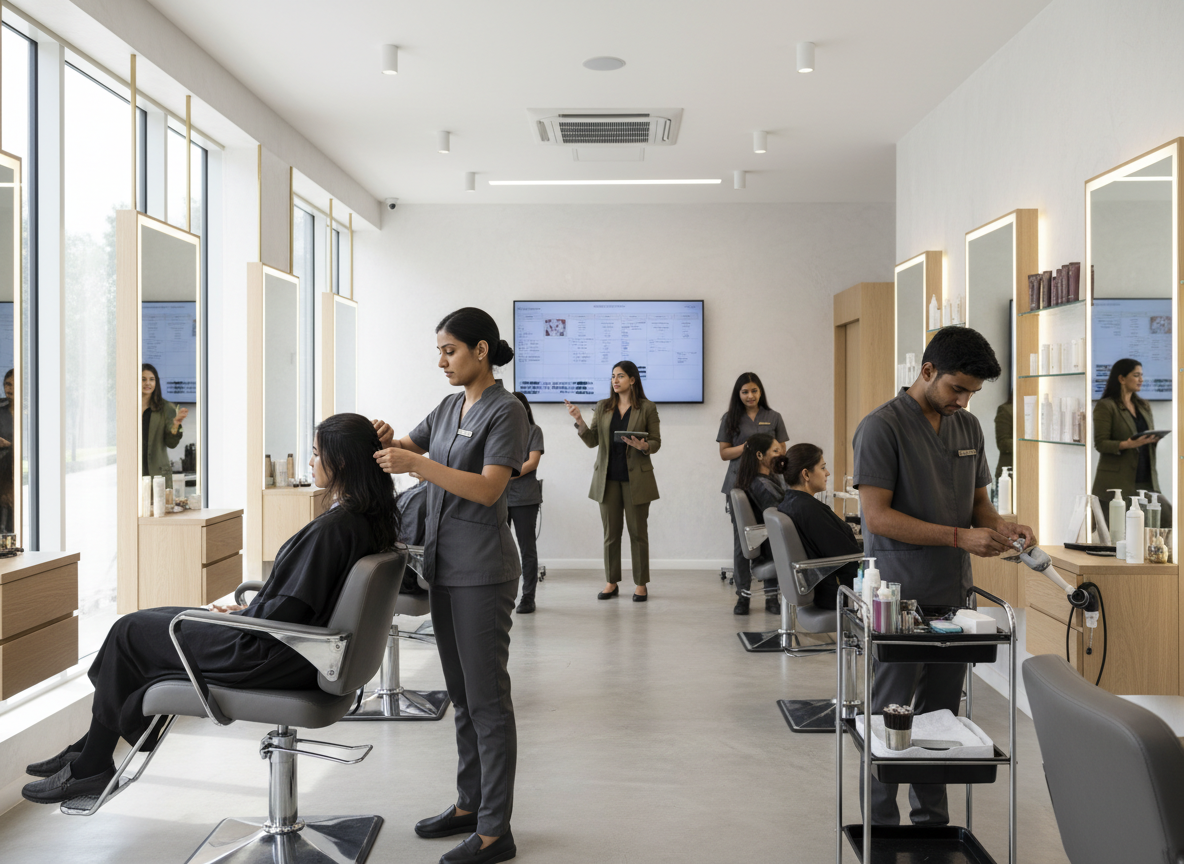
Updated October 2026. A salon is not powered by one generic category of “beauty staff”. Modern beauty businesses increasingly depend on a mix of technical specialists, customer-facing professionals, managers, assistants and commercial roles.
Understanding that workforce matters to both job seekers and salon businesses. Candidates need to know where their skills fit. Owners need to know which capabilities they are actually hiring for.
The main job families inside a beauty salon
| Job family | Typical responsibility |
|---|---|
| Junior / assistant | Supports services, preparation, hygiene and senior professionals while developing practical competence |
| Beautician / beauty therapist | Provides defined grooming, facial, skin and beauty services within training and role scope |
| Hair professional | Cutting, styling, colour and other trained hair services |
| Makeup professional | Occasion, bridal, salon or specialist makeup services |
| Nail professional | Nail care and specialist nail services |
| Front desk / customer experience | Bookings, enquiries, scheduling, billing and client coordination |
| Salon manager | Team, targets, customer experience, scheduling and operating discipline |
| Trainer / educator | Develops technical capability and standardises service execution |
Why salon hiring is more complicated than filling vacancies
A technically competent professional is not automatically a commercially strong salon employee. Service businesses also depend on punctuality, consultation, hygiene, speed, customer comfort, repeat bookings and teamwork.
This is one reason salons can struggle even when candidates hold certificates. The gap between course completion and consistent client-facing execution can be substantial.
What salons should assess before hiring
- Practical demonstration of the services claimed on the CV
- Hygiene and workstation discipline
- Consultation and communication
- Ability to explain products and aftercare appropriately
- Service timing without compromising quality
- Handling of difficult or uncertain client situations
- Portfolio authenticity for specialised roles
- Previous customer-retention or repeat-booking performance where available
- Willingness to follow standard operating procedures
What candidates should assess before accepting a salon job
- Exact services expected in the role
- Fixed salary versus incentives or commission
- Working hours and weekly offs
- Who provides tools and consumables
- Training and assessment process
- Whether targets include retail or service upgrades
- How tips and incentives are handled
- Whether trial work is paid and clearly limited
- Growth opportunities into specialist or management roles
The economics of a salon employee
For a salon owner, salary is only one side of workforce economics. The business also needs to consider utilisation: how much productive service time a professional delivers, what average bill value that capacity creates, and whether the employee helps retain customers. AdvertisR’s Beauty Salon Profit Margin in India guide connects payroll and productive capacity to contribution margin and overall salon profitability.
A professional who retains clients, maintains standards and supports higher-value services can be commercially more valuable than someone whose wage is lower but whose chair remains underutilised.
Technical skill vs customer skill
Professional beauty sits at the intersection of craft and hospitality. Customers experience both the result and the process. A strong haircut delivered with poor consultation can still create dissatisfaction. A technically simple service delivered consistently, hygienically and comfortably can build loyalty.
That makes communication, expectation-setting and service recovery genuine professional competencies rather than “soft” extras.
Freshers and the first salon job
For freshers, the first job should be evaluated partly as an extension of training. Exposure to real consultations, different customer needs, service timing and experienced colleagues can accelerate development.
Candidates should not exaggerate skills to obtain a role. A salon that understands exactly what a fresher can perform independently can assign work more safely and create a clearer progression path.
Specialists can create different career economics
As professionals develop, they may specialise in hair colour, advanced styling, bridal makeup, nails or other technical areas. Specialisation can support stronger positioning, but only when demand, skill depth and repeatable outcomes exist.
Being able to name a specialised service is not the same as being commercially proficient in it. Portfolios, practical assessment and customer outcomes remain important.
From technician to salon manager
Management is a different skill set. Strong technicians do not automatically become strong managers. Salon managers may need to handle rostering, targets, complaints, stock coordination, team performance, customer experience and operating discipline. AdvertisR’s Salon Management in India 2026 guide explains how those responsibilities fit into the wider operating system of a profitable salon.
For ambitious professionals, learning these commercial skills can open a pathway beyond service delivery alone.
Where beauty education fits
Training remains the entry point for many roles, but the useful question is whether the course develops employable capability. Students can compare AdvertisR’s Beautician Course in India 2026, Cosmetology Course in India 2026 and Makeup Artist Course in India 2026 guides.
Looking specifically for beautician work?
Our Beautician Jobs in India 2026 guide covers fresher roles, salary factors, home-service work, freelancing and career progression in more detail.
Why workforce quality matters to the Indian beauty industry
Salon growth depends on more than consumer demand. A business cannot sustainably sell services it cannot consistently deliver. Workforce capability therefore affects customer trust, capacity, pricing, retention and expansion.
As organised salon businesses and professional beauty brands grow, training quality and workforce development become business infrastructure, not merely education topics.
The AdvertisR view
The salon workforce is one of the least discussed parts of India’s beauty economy. Yet nearly every service-business growth question eventually reaches people: who performs the service, how well they perform it, how they are trained and whether customers trust them enough to return.
That is why AdvertisR treats salon jobs as part of the business of beauty rather than simply as a recruitment category.
For the broader structural picture, explore our India Professional Beauty Workforce & Skills Map 2026.
AdvertisR is an independent beauty-business publication. Job responsibilities, compensation and employment conditions vary by employer, city and experience. Candidates and employers should verify current terms directly.