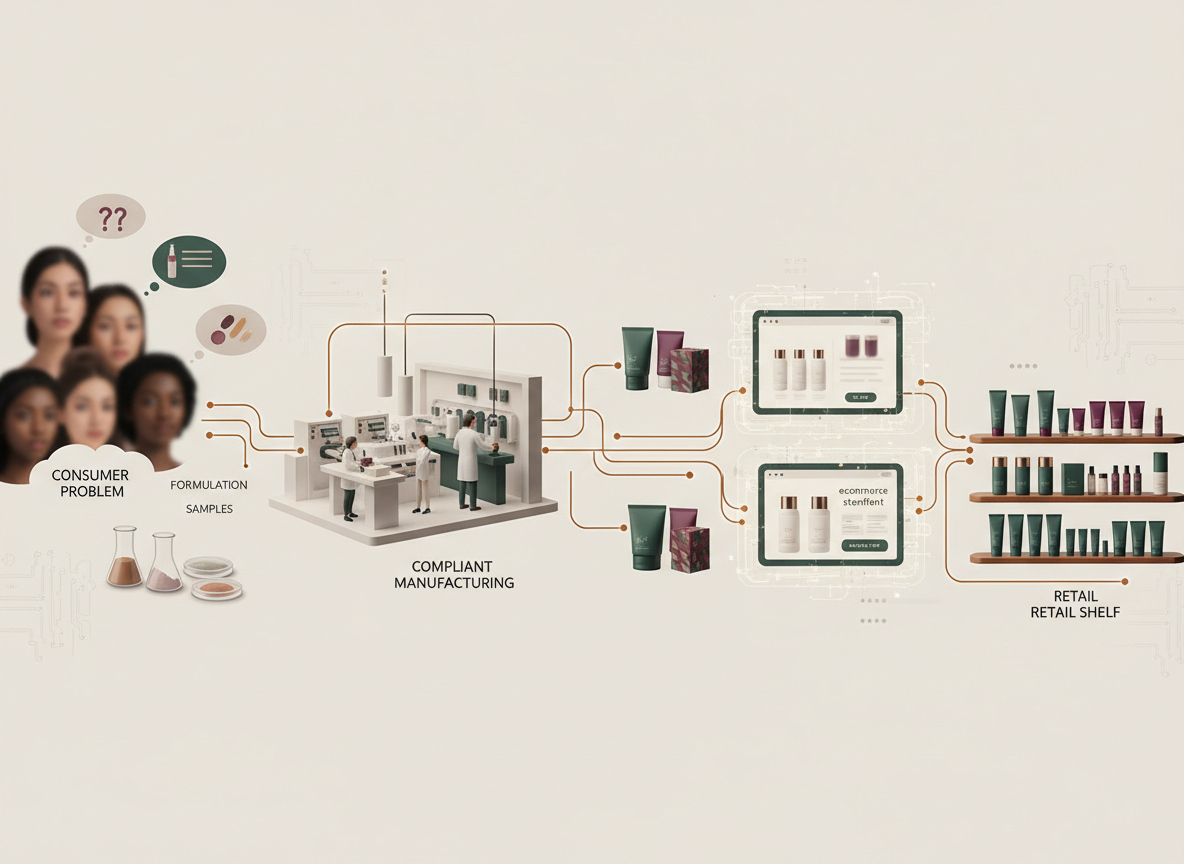
Starting a cosmetic brand in India has become operationally easier and commercially harder. Manufacturers can help develop products, ecommerce infrastructure can be launched quickly and marketplaces offer national distribution. The difficult part is building a product and operating model that customers choose again after the launch campaign ends.
This AdvertisR roadmap approaches a beauty launch as a business system: customer problem, product, compliance, manufacturing, unit economics, distribution and repeat demand.
1. Start with a problem, not a product catalogue
A new brand rarely needs ten or twenty SKUs at launch. Define the customer, the problem and why the proposed product deserves to exist. A narrow hero-product thesis makes formulation, messaging, inventory and customer feedback easier to manage.
2. Decide the formulation and manufacturing model
Founders can use an existing private-label formulation, customise a manufacturer base or develop a more proprietary formula. Each option changes launch time, MOQ, differentiation and ownership. Manufacturer selection should include licensing, quality systems, testing, packaging capability, lead time and the right to move production later.
3. Map regulatory requirements before packaging is printed
Cosmetics manufactured in India operate under the Cosmetics Rules, 2020 and applicable standards. CDSCO’s guidance states that manufacturing licences are issued by State Licensing Authorities. New cosmetics can require prior Central Licensing Authority permission, and labelling must comply with the rules.
This work should happen before final artwork because ingredients, manufacturer information, declarations and claims can affect the pack. Reprinting thousands of cartons is an expensive way to discover a compliance problem.
4. Build unit economics before setting MRP
Include formula, packaging, freight, testing, warehousing, payment gateway, marketplace commission, fulfilment, returns, discounts, creator commissions and advertising. Then model economics separately by channel. A product that works on a brand-owned website may become unattractive after marketplace fees and discounting.
5. Treat packaging as operations as well as branding
Packaging has to survive filling, transport, storage and consumer use. Check compatibility with the formula, dispensing performance and supplier MOQs. Custom components can improve distinctiveness but can also lock working capital into packaging inventory before product demand is proven.
6. Choose channels by job
Your own website can provide first-party data and brand control. Marketplaces add reach and purchase trust. Specialist beauty platforms add category discovery. Quick commerce can provide convenience and, increasingly, discovery. Offline retail enables trial. Do not enter every channel simply because it exists.
7. Design launch content around customer risk
Beauty customers worry about efficacy, suitability, shade, irritation, authenticity and disappointment. Product content should answer those risks with demonstrations, ingredient explanation, application guidance, realistic expectations and clear policies rather than relying only on aspirational imagery.
8. Measure repeat demand before scaling acquisition
A launch can generate revenue through discounts and paid media without proving product-market fit. Track repeat purchase, refund and return reasons, ratings, customer-service questions, contribution margin and cohort behaviour before aggressively increasing acquisition spend.
What does a strong first year look like?
For many young beauty companies, a strong first year is not maximum SKU count or maximum follower growth. It is evidence that one or two products have repeatable demand, compliant and reliable supply, positive customer feedback and a channel mix that can scale without destroying margin.
Continue the launch research: Use our cosmetic manufacturer evaluation guide, compare the private-label route, check India’s cosmetics compliance framework and plan packaging and supplier economics before committing inventory.
AdvertisR’s view: the safest sequence is prove the problem, prove the product, prove repeat demand and only then widen distribution. Beauty brands fail when marketing scales faster than the operating system underneath it.
Regulatory note: this is a business roadmap, not legal advice. Founders should verify current product-specific requirements with the relevant Indian licensing authority and qualified regulatory professionals.