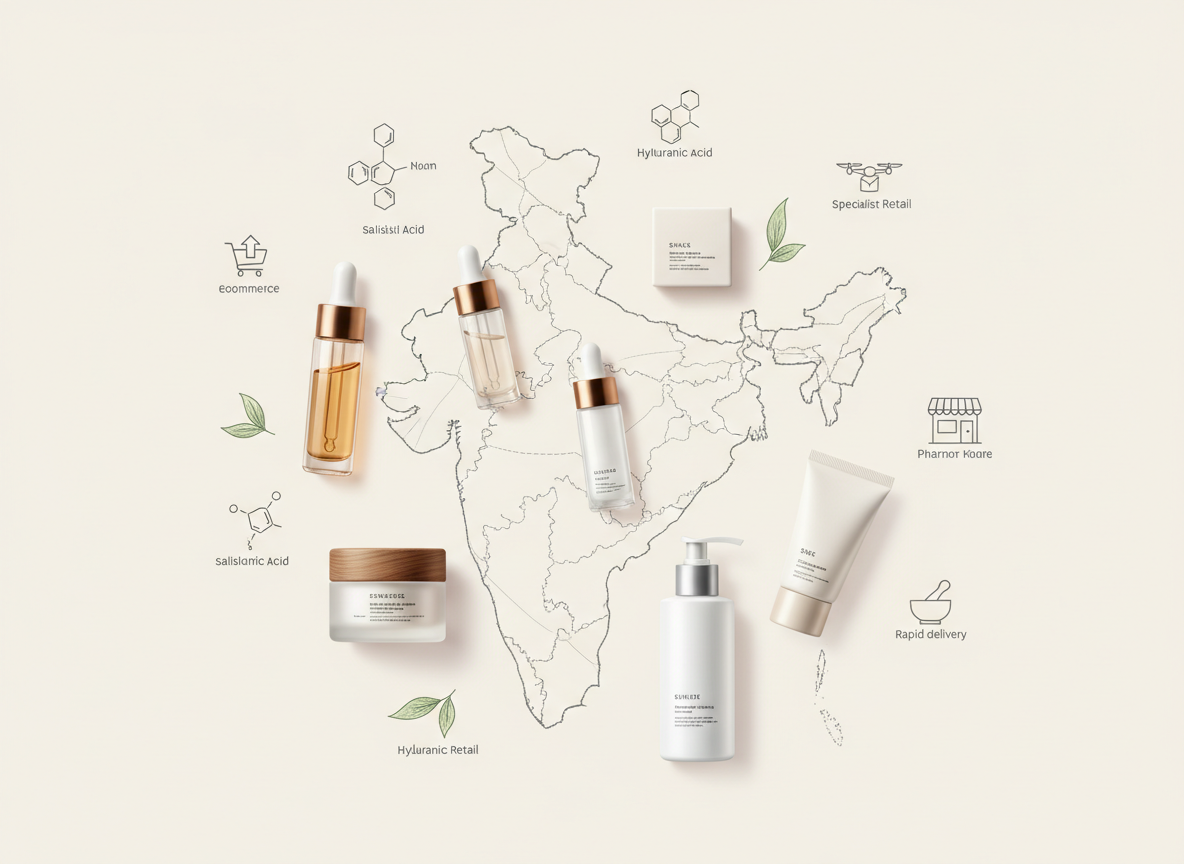
India’s skincare market in 2026 spans legacy mass brands, ingredient-led digital challengers, dermatologist-positioned labels, premium international businesses, retailer-owned portfolios and professional skin systems. That makes a simple list of popular skincare names increasingly inadequate.
This AdvertisR guide maps skincare brands in India from a business perspective: ownership, positioning, price architecture, route to market and the operating forces determining which brands can scale. It is not a product-quality ranking or a substitute for dermatological advice.
How India’s skincare-brand market is structured
Indian skincare can broadly be viewed through five overlapping groups: established consumer brands, digital-first Indian challengers, retailer-linked portfolios, premium and international skincare, and professional or clinic-adjacent brands. Many now compete across the same ecommerce and retail shelves.
For the wider ownership picture across makeup, haircare, skincare and professional beauty, see AdvertisR’s Beauty Brands in India 2026 map.
Leading skincare brands in India: how to read the market
Searchers looking for the best skincare brands in India or top skincare brands in India are often comparing very different businesses under one label. A mass moisturiser brand, an ingredient-led D2C company, a Korean skincare label and a luxury clinical proposition may all compete for skincare spend, but their price points, distribution systems and reasons for purchase are fundamentally different. AdvertisR therefore treats “leading” as a market-structure question rather than a subjective product ranking.
1. Ingredient-led skincare changed how Indian consumers discover brands
The digital skincare wave made ingredients part of mainstream beauty language. Niacinamide, salicylic acid, retinoids, ceramides, vitamin C and sunscreen filters became discovery terms as well as formulation components.
Brands such as Minimalist and The Derma Co helped popularise a science- and ingredient-forward presentation, while newer businesses including Foxtale compete in the same digitally informed consumer environment. The commercial advantage of ingredient literacy is clearer product communication; the risk is that competing brands can begin to sound interchangeable.
2. Indian digital-first skincare is becoming omnichannel
D2C websites and marketplaces lowered the initial distribution barrier for emerging skincare companies. But scale increasingly requires more than paid social acquisition. Brands are expanding into specialist beauty retail, modern trade, pharmacies and other offline formats while marketplaces remain important for discovery and replenishment.
This changes the operating model. An online-first skincare business needs to manage store inventory, marketplace pricing, distributor margins and retail merchandising without losing the customer insight that made D2C valuable in the first place.
3. Retail platforms increasingly participate in brand ownership
India’s specialist beauty platforms are not only retailers. Nykaa’s broader ecosystem includes controlled or owned beauty businesses such as Dot & Key, Earth Rhythm and Aminu Wellness, creating a model where consumer discovery, distribution and brand ownership can sit inside the same platform ecosystem.
For independent skincare brands, that means retail platforms can simultaneously be customers, media channels, data-rich merchandising partners and competitors for consumer attention.
AdvertisR follows these ownership shifts through its India Beauty Capital Map 2026.
4. Large consumer groups are buying access to newer skincare demand
Strategic acquisitions demonstrate that newer skincare capabilities can be valuable to established consumer groups. The attraction can include digital consumer relationships, premium positioning, formulation narratives, faster-growing subcategories and younger audiences.
This is part of a broader convergence between legacy FMCG and digital beauty. Large companies bring distribution and capital; younger brands can bring category momentum and a more focused consumer proposition.
5. Korean and international skincare broaden the consideration set
K-beauty and international skincare have widened Indian consumers’ exposure to formats, routines and product concepts. Marketplaces, specialist retailers and creator content allow global skincare trends to reach Indian consumers faster than traditional premium-store expansion alone.
International beauty groups are also deepening local strategies through distribution partnerships, dedicated operating structures and selective launches. AdvertisR’s India Beauty Entry Tracker 2026 follows these routes into the market.
Korean skincare brands in India are best understood as a distribution and discovery shift, not one homogeneous segment. K-beauty ranges can enter through specialist beauty retailers, marketplaces, distributors and brand-led ecommerce, while creator education helps unfamiliar formats and routines travel quickly. For operators, the questions are local availability, authorised distribution, price architecture, replenishment and whether a globally popular routine translates into durable Indian demand.
6. Sunscreen has become a strategic skincare category
Sunscreen illustrates how skincare can move from an occasional or expert-led purchase toward a broader daily-use proposition. The category attracts Indian digital-first brands, mass players, dermatology-positioned labels and international entrants.
That competition makes formulation experience, claims, education, price and repeat behaviour especially important. A high-search category can generate trial quickly, but durable value depends on whether consumers incorporate the product into a routine.
7. Premium skincare demand is expanding beyond metros
Ecommerce has reduced the geographic barrier to premium skincare discovery. Consumers in smaller cities can access many of the same global and Indian premium brands as metro shoppers even when local physical assortment is narrower.
Luxury skincare brands in India compete on more than higher price points. Prestige distribution, consultation, formulation narratives, sensorial experience, global brand equity and controlled discounting all influence whether premium positioning survives at scale. Ecommerce is widening access, but luxury skincare still depends on trust and service, making selective offline presence and specialist beauty retail strategically important alongside digital availability.
This does not make Tier-2 and Tier-3 India one homogeneous market. Climate, income, logistics, local retail and category familiarity vary substantially. AdvertisR’s premium beauty beyond metros analysis examines the wider business signal.
8. Quick commerce is changing skincare replenishment
Skincare contains products well suited to replenishment: cleansers, moisturisers, sunscreen and selected routine staples. Rapid-delivery platforms can therefore compete for high-frequency purchases where the consumer already knows what they want.
Discovery-heavy serums, treatments and premium routines may behave differently. Brands should evaluate quick commerce SKU by SKU rather than treating it as another marketplace catalogue.
How to compare skincare brands in India as businesses
| Dimension | What matters |
|---|---|
| Ownership | Founder-led, listed company, strategic parent, retailer-linked or multinational |
| Positioning | Mass, masstige, premium, dermatology-positioned, natural/ayurvedic or professional |
| Hero need-state | Acne, pigmentation, hydration, barrier care, anti-ageing, sun protection or general routine |
| Distribution | D2C, marketplace, pharmacy, specialist beauty, modern retail, general trade or quick commerce |
| Trust system | Clinical evidence, ingredient education, dermatologist association, creators, reviews or heritage |
| Economics | Repeat rate, gross margin, acquisition cost, discount dependency and inventory velocity |
What determines whether a skincare brand can scale?
- Repeat purchase. Skincare can create attractive recurring demand, but only when the product earns a place in the routine.
- Credibility. Claims need sufficient evidence and communication discipline, particularly when brands use clinical or dermatologist-adjacent positioning.
- Portfolio logic. Too many overlapping products can create consumer confusion and inventory complexity.
- Channel economics. Marketplace discounts, retail margins and D2C acquisition costs need to coexist without destroying price architecture.
- Education. Consumers increasingly understand ingredients, but brands still need to explain suitability, usage and realistic expectations.
- Availability. Once a routine product wins repeat demand, stock-outs create an opening for substitution.
Natural, ayurvedic and science-led skincare are not mutually exclusive
Indian skincare is often framed as a contest between natural or ayurvedic positioning and clinical or science-led skincare. In practice, consumer propositions increasingly overlap. Brands can use botanical ingredients while communicating efficacy, or use modern actives while emphasising gentleness and barrier health.
The business challenge is differentiation. As more companies use similar ingredient and efficacy language, trust, formulation experience, proof and brand identity become harder to replicate than the ingredient list itself.
Organic and ayurvedic skincare brands in India remain a meaningful discovery cluster, but the commercial labels can cover very different propositions. “Natural”, “herbal”, “organic” and “ayurvedic” should not be treated as interchangeable proof claims. For brands, the stronger long-term position is to make precise, supportable claims, explain formulation choices clearly and build repeat demand around product performance rather than relying on a broad naturalness halo alone.
What retailers and distributors should evaluate
- repeat sell-through rather than launch orders;
- hero SKU concentration and portfolio productivity;
- expiry and inventory risk;
- online discounting versus offline economics;
- consumer search and creator demand;
- claims and labelling discipline;
- tester or consultation requirements where relevant; and
- replenishment reliability.
Where skincare fits in India’s beauty market
Skincare sits inside a wider beauty system that includes cosmetics, haircare, fragrance, personal care and professional beauty. Each category has different repeat cycles, assortment complexity and routes to market.
AdvertisR’s India Beauty Industry 2026 guide maps that broader structure, while the Cosmetic Brands in India 2026 page covers the adjacent makeup-brand ecosystem.
Continue through AdvertisR’s category intelligence: Compare the Cosmetic Brands in India 2026 map for makeup and colour cosmetics, use the D2C Beauty Brands in India analysis for digitally native operating models, and follow Emerging Beauty Brands in India for younger challengers still building distribution and repeat demand.
The AdvertisR view
The strongest shift in Indian skincare is not simply the arrival of more brands. It is the increasing sophistication of the consumer and the resulting pressure on brands to prove why they deserve a permanent place in a routine.
Digital discovery can create rapid trial, but sustainable skincare businesses need repeat purchase, credible claims, disciplined portfolios, reliable availability and channel economics that survive beyond promotional acquisition.
Sources & verification
AdvertisR uses company disclosures, regulatory filings, retailer announcements and source-backed industry reporting to verify ownership, acquisitions, distribution and strategic developments referenced in this guide. Brand examples are non-exhaustive and are included to explain market structure rather than rank product quality or make medical claims. Ownership, formulations, claims and distribution relationships can change and should be rechecked for commercial decisions.